Textile designer Ellen Parro’s archive is now on display at the ETDM gallery
23.3.2026
Exhibition
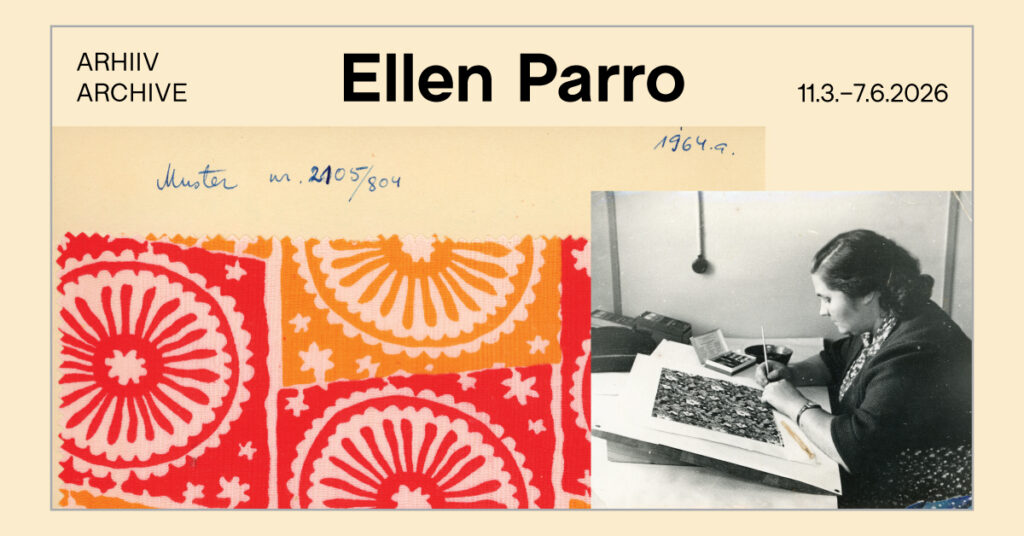
On March 11th, the gallery of the Estonian Museum of Applied Art and Design opened an exhibition featuring textile artist Ellen Parro’s archival materials.
Museums expand their collections in various ways. Sometimes the focus is on a theme for which a future exhibition is being planned. In such cases, attention is directed to the materials related to the theme, and efforts are made to find objects that are still missing from the collection. At times, something is noticed that the owner is not yet ready to part with, and an agreement is made that when the right moment comes, the owner will offer the object to the museum first. Until then, it is on loan. Occasionally, the museum is offered something completely unexpected. Sometimes materials that have arrived wait for their time, while at other times, new materials are incorporated into upcoming projects, exhibitions, or books. Occasionally, there is a strong desire to share something as quickly as possible with as many people as possible.
“Archive” is a series through which we introduce archival materials that have arrived at the museum, showing how they help to diversify and expand our knowledge of Estonian applied art and design heritage.
Ellen Parro (1927–1985) was an Estonian textile designer. She worked for nearly twenty years as an industrial artist at the Sindi Textile Factory, which was named after the 1st of December. In line with the era, her role was to be an anonymous part of the large industrial machinery. Although her job was to design printed fabrics, whose patterns are familiar to several generations, she remained unknown as a designer. Through the archival materials that have reached the museum, the nature of the work and life of an industrial artist in the early Soviet period becomes clear—routine, lifestyle, and opportunities.
Ellen Parro studied knitting at the Tallinn I Women’s Vocational School in 1943, continued her studies at the Tallinn Light Industry Technical School, and graduated in 1947 in the field of decorative weaving, receiving a qualification as a technician-technologist. Between 1947 and 1953, she studied artistic textile design at the State Art Institute. After graduation, Parro worked as an artist at the Sindi factory. This remained her only workplace until 1982, though her job titles changed slightly over time. In addition to her factory work, she also created products, such as folk costume belts and garter straps, for the folk art collective Uku.
Ellen Parro’s assignment to the Sindi factory marked the beginning of the period when industrial artists were included in manufacturing companies. Her job became designing printed fabrics, and until 1964, more than a hundred samples ranging from stylized floral ornaments to abstract geometric solutions have survived.
The relatively routine and exhausting nature of industrial work was offset by training courses that opened up professional perspectives within the factory system. In 1963, Ellen Parro completed qualification enhancement courses with the Estonian SSR Council of National Economy, and in 1973, she attended a designer course at the Estonian SSR Ministry of Light Industry’s Training Combine. When Parro started working as an artist at the factory in 1953, she was awarded the III category level in 1961 and the II category level in 1963. In 1965, when the production of printed fabrics was transferred to the Kreenholm Manufacturing Company, she became a designer of woolen outerwear for the art-experimental studio. In 1968, she continued as a designer, responsible for tasks such as designing fabric textures and calculating the requirements for knitting. In 1979, she became a mass-production knitting designer. In 1982, Ellen Parro retired after nearly 30 years at the factory.
The materials carefully preserved by Ellen Parro were donated to the museum by her relatives in 2025. Among the materials are several personal documents, including those from creative assignments abroad, as well as photographs. From the perspective of design history, the most fascinating part is the complete collection of the printed fabric samples designed by her and produced in Sindi from 1954 to 1964.
We would like to thank Ellen Parro’s relatives for this generous donation.
Exhibition team: Kai Lobjakas, Ketli Tiitsar, Toomas Übner, Sandra Sirp