Performance at the exhibition “The Whole World a Bauhaus”
2. May at 11.30
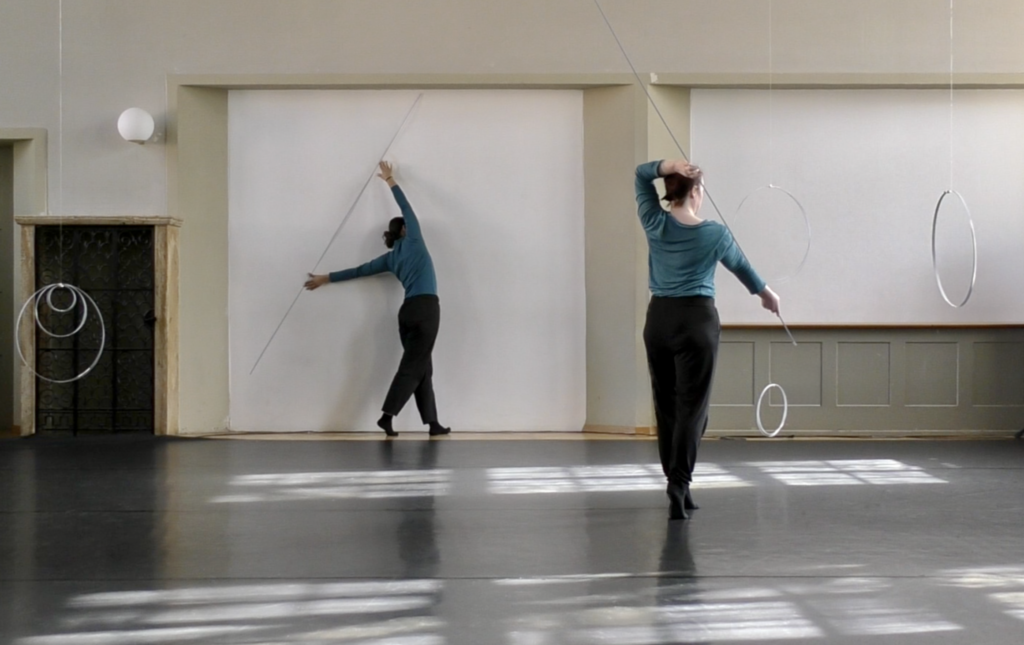
On May 2, an all-day durational performance “floating lines going for a walk” will take place at the exhibition “The Whole World a Bauhaus.”
“floating lines going for a walk” is a durational performance featuring two dancers and several linear and circular white metal objects that move freely within the exhibition “The Whole World a Bauhaus.”
This immersive performance offers an opportunity to closely observe a laboratory-like situation in which the dancers explore the relationship between their bodies and flexible, tensioned objects. The work is primarily inspired by the themes of the exhibition – floating and experimentation – as well as ideas from Bauhaus pedagogy, particularly the introductory courses and material studies focused on tension and balance.
In this intimate setting, lines and circles take center stage, along with their transformation from two-dimensional to three-dimensional forms – in a broader sense, the transition from drawing to sculpture – offering the audience a contemporary perspective on the artistic process.
The performance can be seen at the exhibition at the following times:
11:30–13:00
14:00–15:30
16:30–18:00
Concept, choreography, performance, tensioned objects: Eva Baumann
Co-author and performer: Aurora Bonetti
Research, dramaturgical consultation: Katja Vaghi
Eva Baumann is a dancer, movement researcher, choreographer, and teacher with a diverse educational background. She studied contemporary and classical dance at the University of Music and Performing Arts in Frankfurt am Main, Germany. She later studied choreography at Codarts University of the Arts (Hogeschool voor de Kunsten) in Rotterdam. Her artistic career as a dancer and choreographer began in 2006 in the Netherlands, where she created her first works, co-produced and supported by Korzo Theater in The Hague and Dansateliers Rotterdam. She currently lives and works in Stuttgart and Berlin.
The exhibition “The Whole World a Bauhaus” presents a diverse, engaging, and surprising insight into the work and life of the Bauhaus art school through eight thematic chapters. It focuses on one of the most important art schools of the 20th century, founded in 1919 in Weimar. Through photographs, original drawings, models, documents, films, and objects, the exhibition invites visitors to explore the wide scope and diversity of Bauhaus modernist design theory and practice.
The exhibition is curated by Boris Friedewald and is organized in collaboration with the Goethe-Institut.