Conversation with Helga Schmid and Tõnis Jürgens at “Uneversum: Rhythms and Spaces”
27.10 at 17
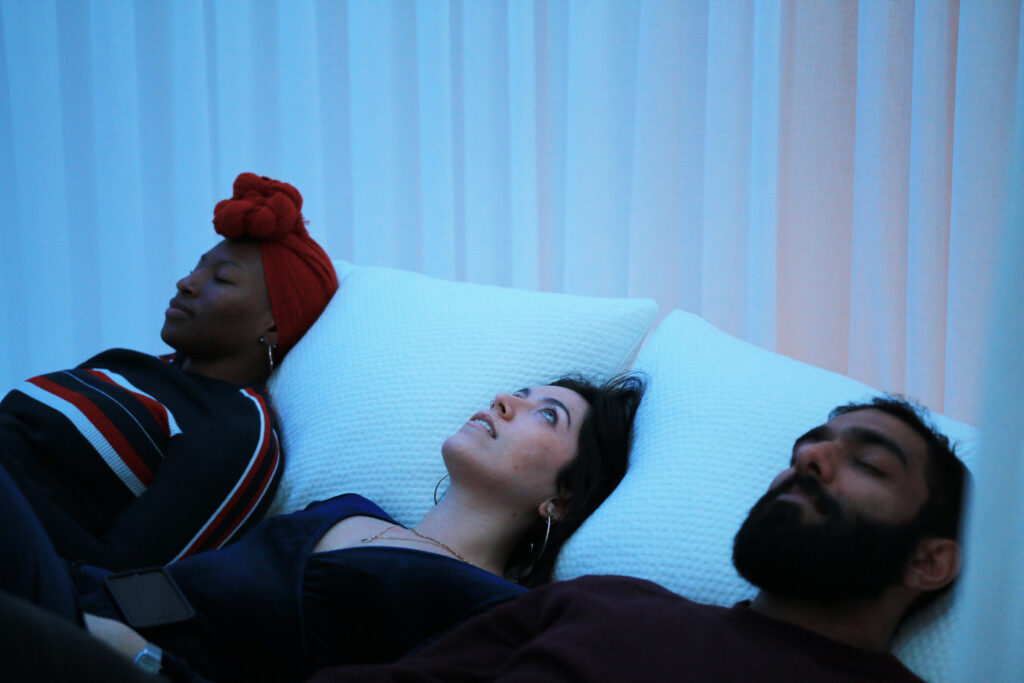
The exhibition “Uneversum: Rhythms and Spaces” explores the relationship between radical ideas and the everyday as they interact with sleeping spaces, environments, and time and timekeeping. It begins with the oppressive crisis of time and moves on to examine the idealisation of organisation and functionality and the desire for mechanical efficiency.
London-based designer Helga Schmid and Tallinn-based artist Tõnis Jürgens will present their work and discuss time crises, natural rhythms, sleep modes, and sleep tracking in the context of their pieces in the exhibition.
Schmid’s installation “Circadian Dreams” (2019) invites visitors to lie down on a bed, where light and soundscape relate to our body phases from different times of the day. Her work directs our attention to our body rhythms, and the installation supports this experience. One of the project’s starting points is the contemporary crisis of time. With the growing use of the mechanical clock, a continuous desynchronization process between the social construct of time and natural rhythms started to develop from the 15th Century on. Studies indicate that people in Western societies feel under increasing time pressure and frequently complain about the scarcity of time.
Tõnis Jürgnes has a new video installation “Sleep with Pointing” (2023). In his video essay, Tõnis Jürgens envisages sleep as an interval between two consecutive film frames or images. In film, an optical illusion known as the persistence of vision helps create the impression of motion, merging static images into a continuous sequence in the viewer’s mind. Jürgens likens the alignment of images on a film strip to how sleep frames our waking moments as a stagnant void in time. The proliferation and widespread adoption of sleep-tracking devices have normalised the mindset of surveillance capitalism. Smartwatches, activity monitors, and software applications used for self-tracking generate hidden data that can be used to forecast consumer behaviour and sold as valuable information. In the realm of digital self-care, free labour is rife.
The conversation is moderated by Sandra Nuut in English.
Admission is with a museum ticket (8 / 4 euros) with which it is possible to visit all the exhibitions. No prior registration is necessary.
The “Uneversum” exhibition project is the result of a collaboration between the Estonian Museum of Applied Art and Design, the Estonian Theatre and Music Museum, and the Estonian Health Museum.